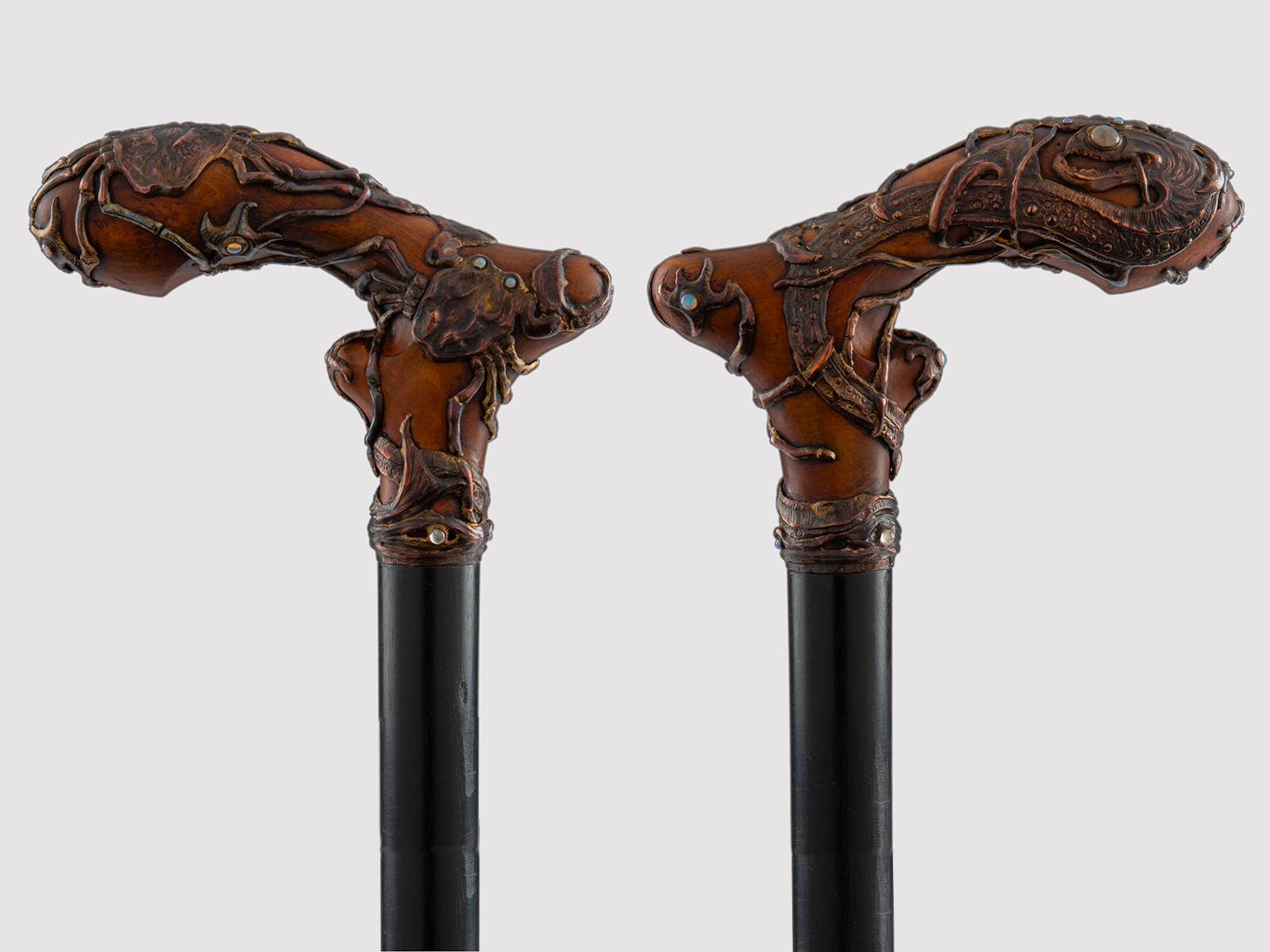
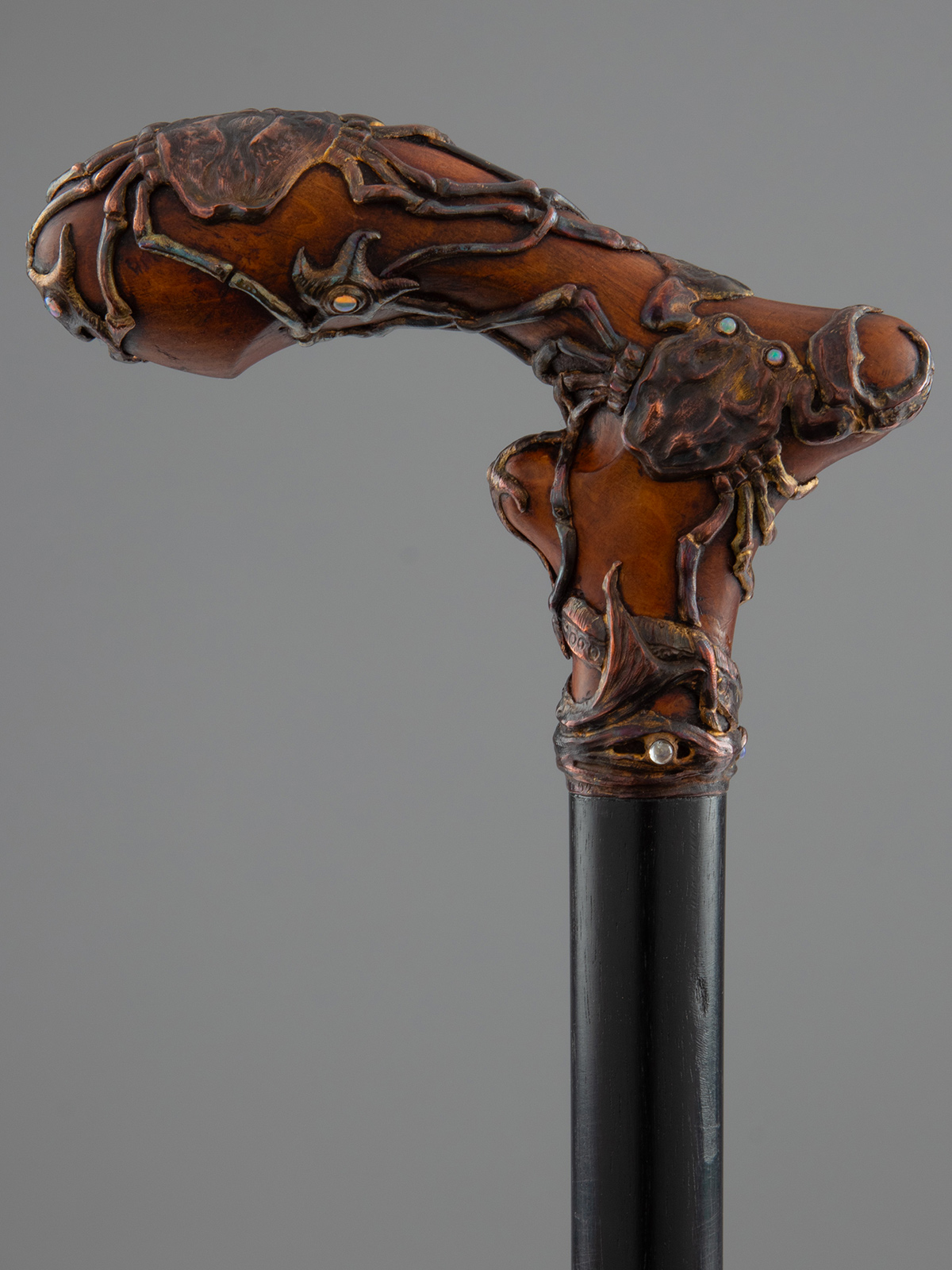
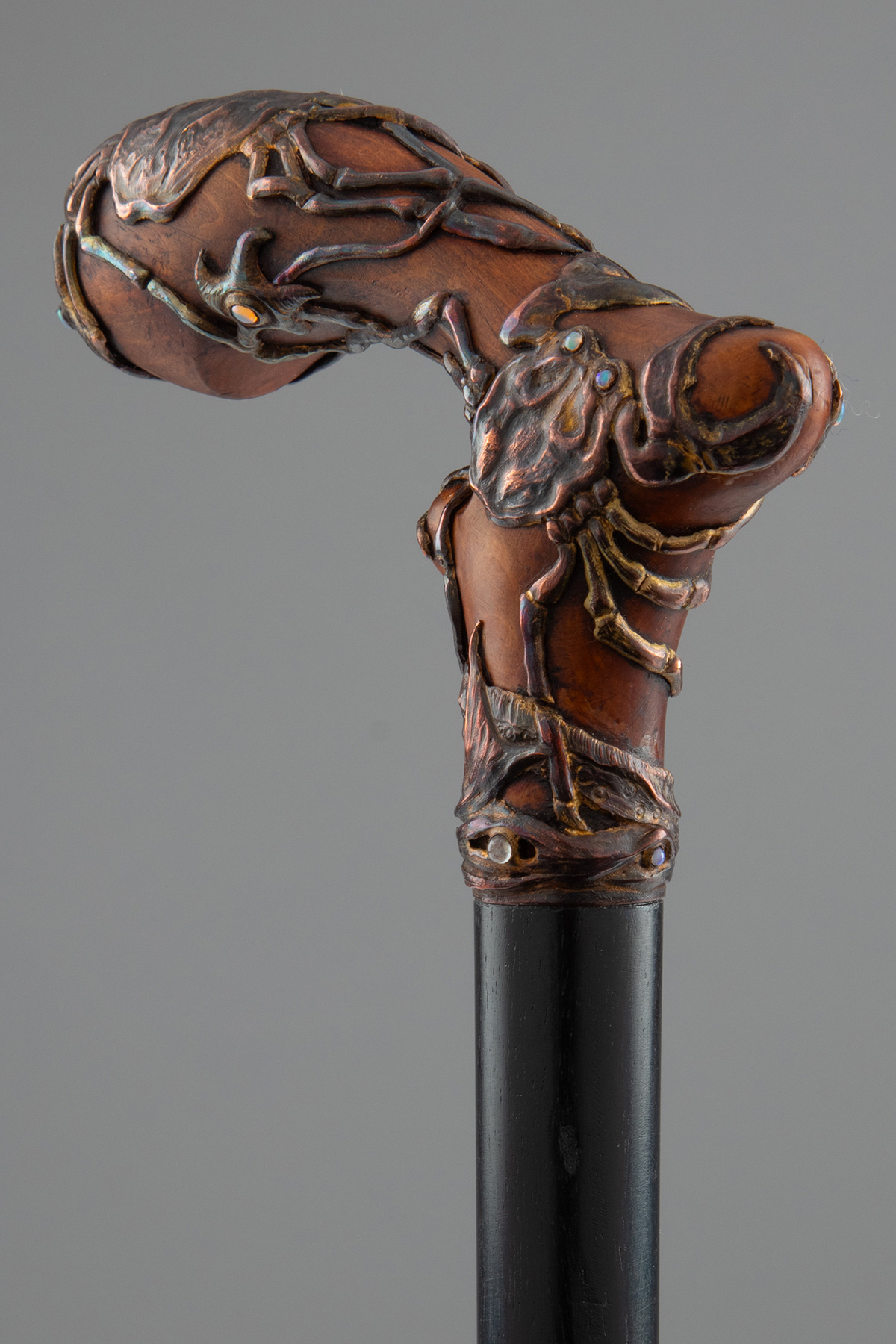
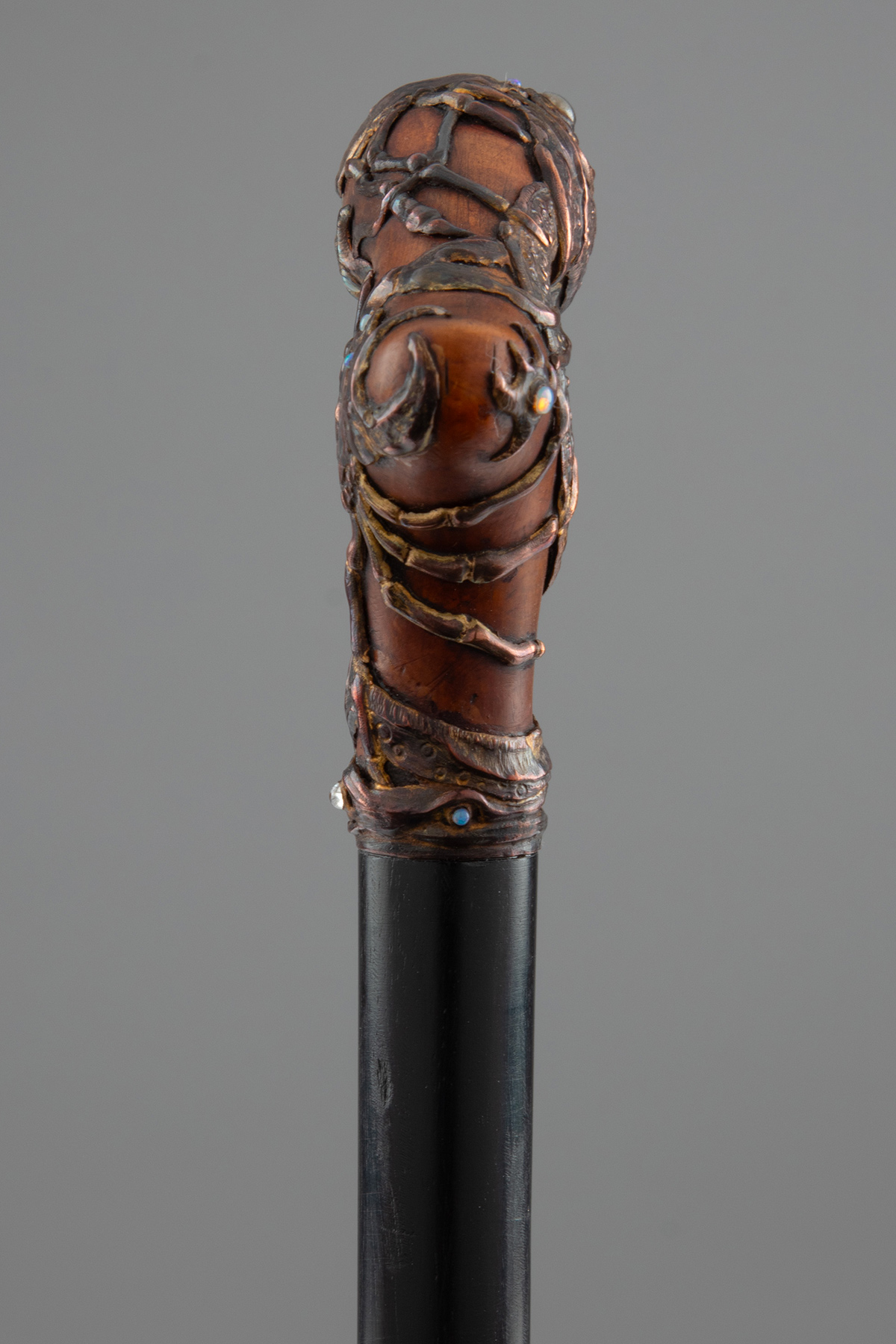
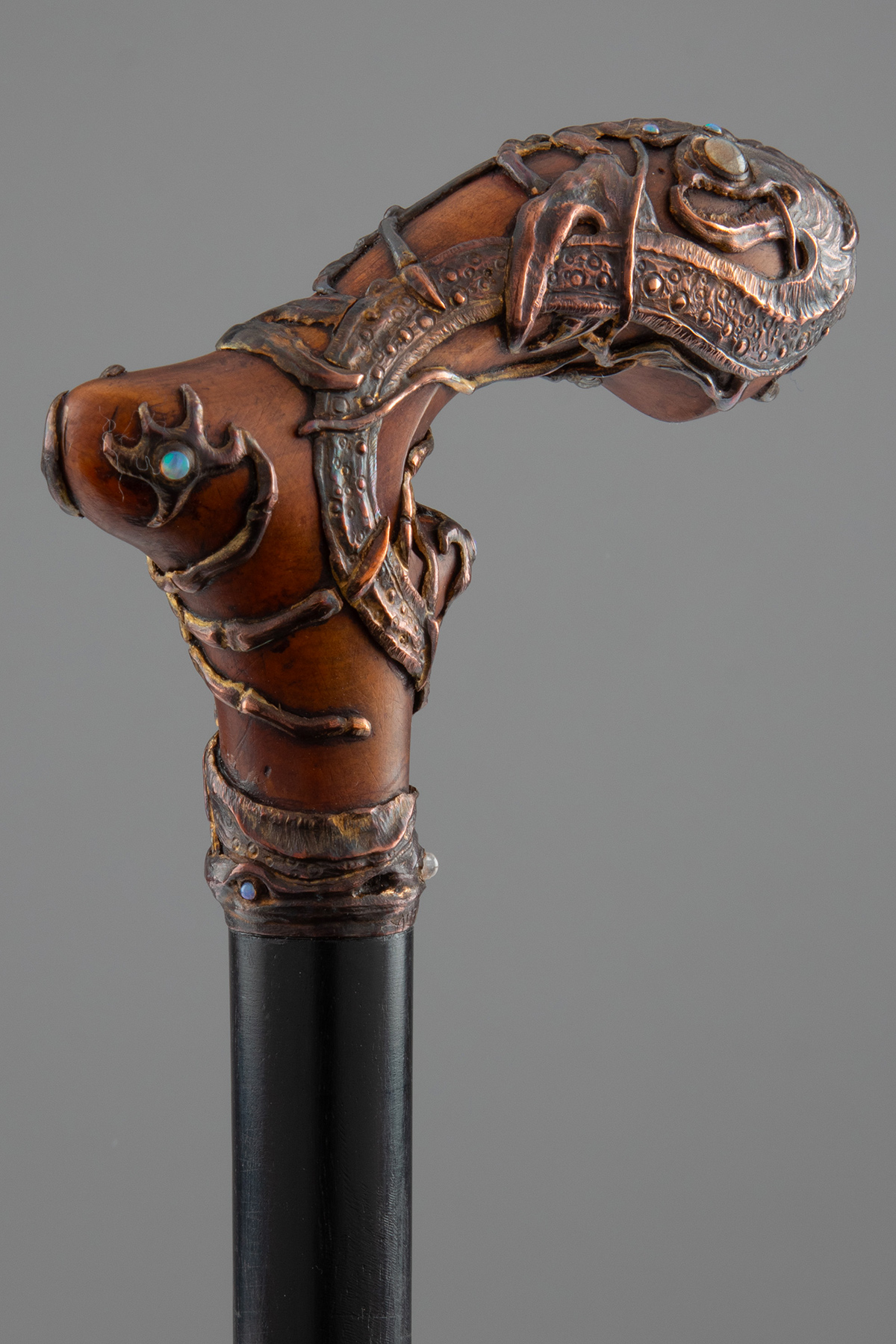
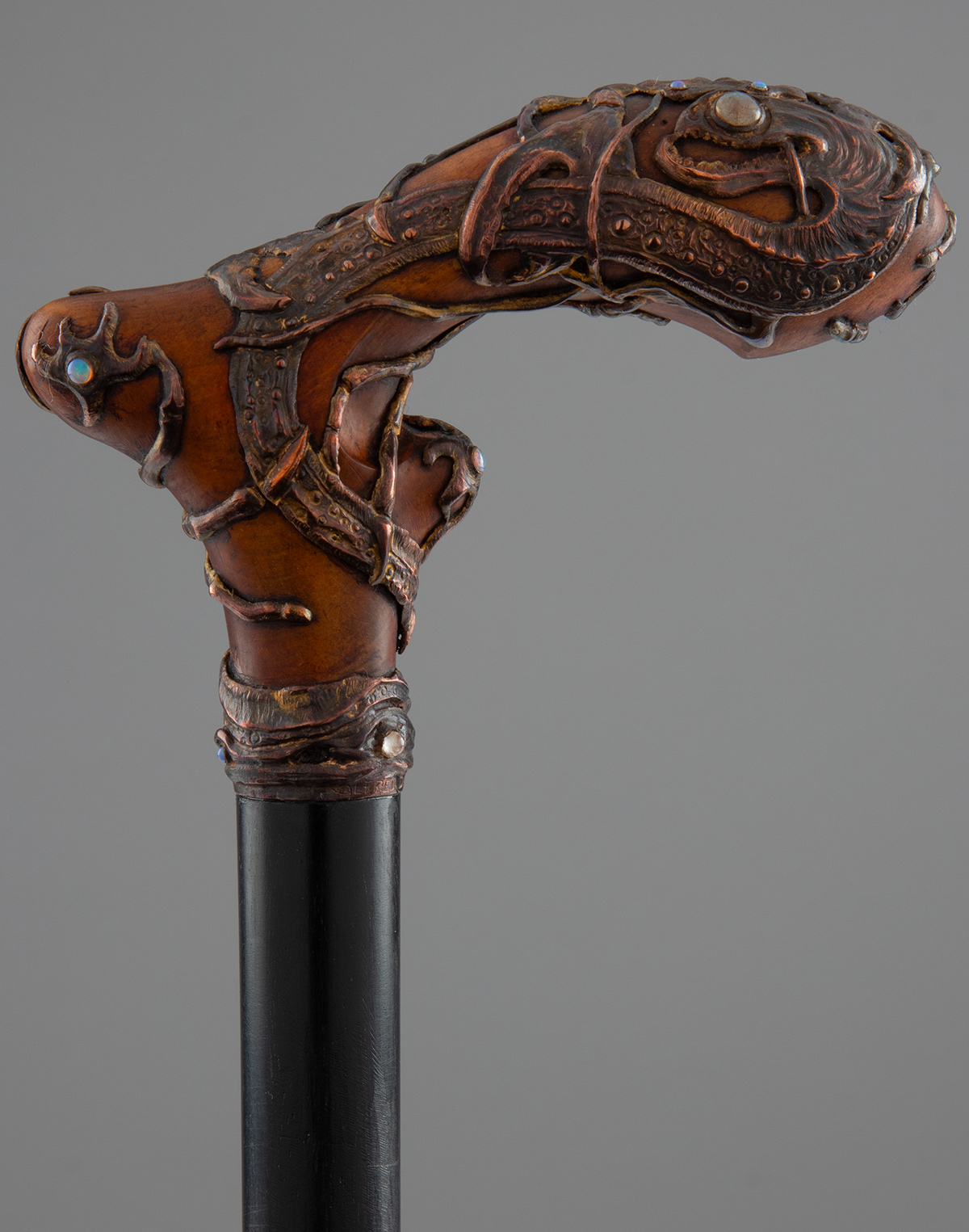
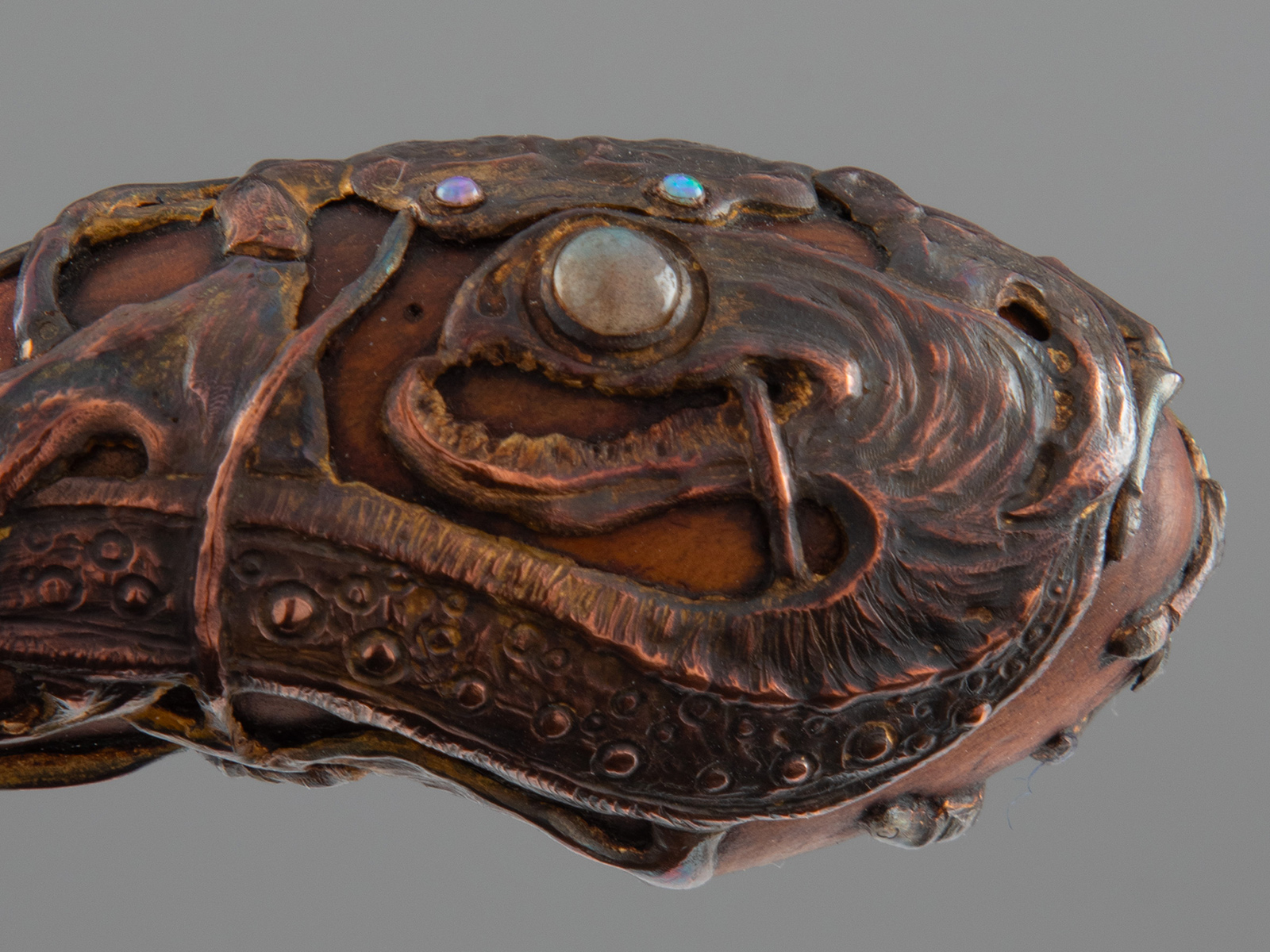
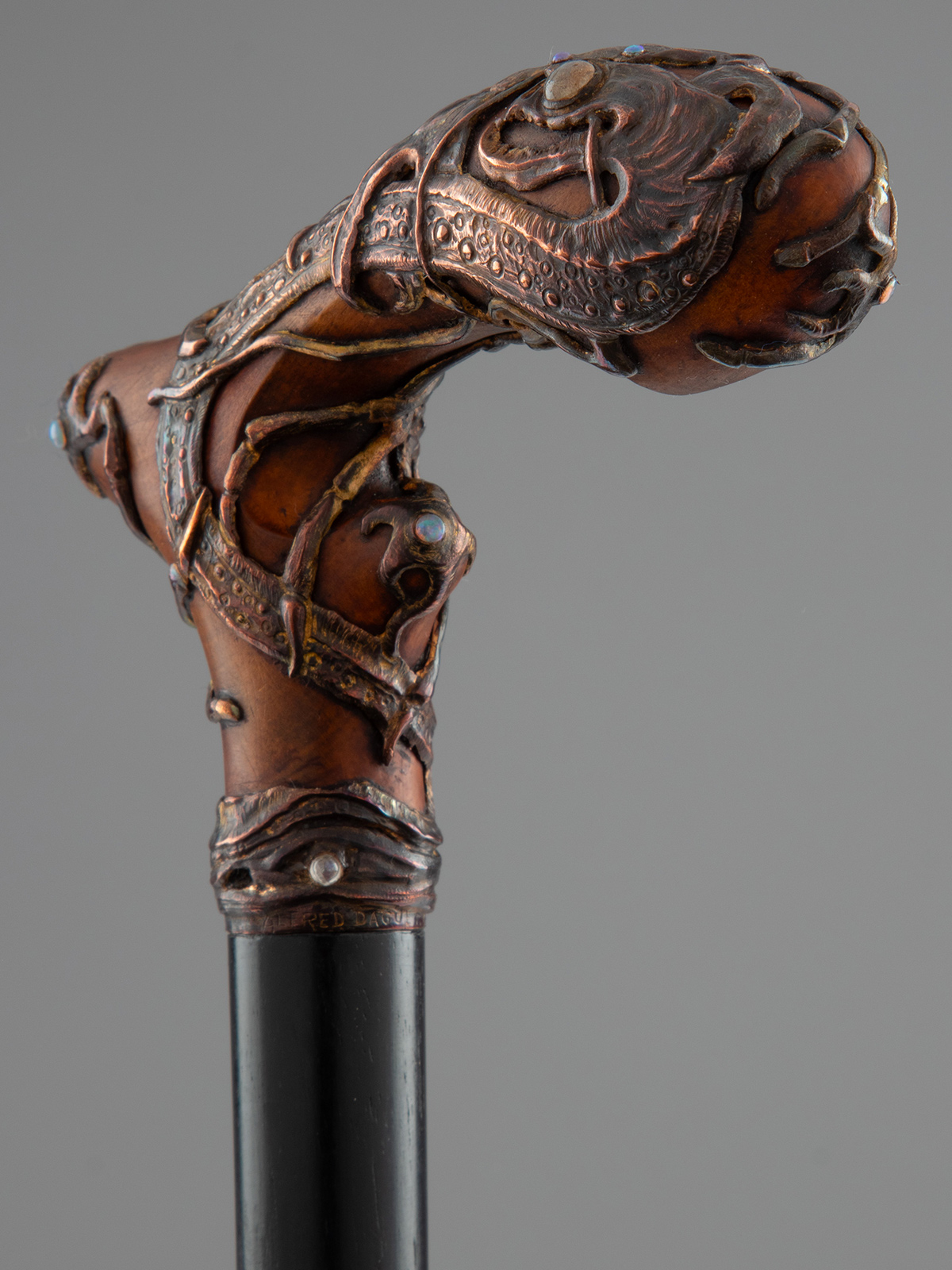
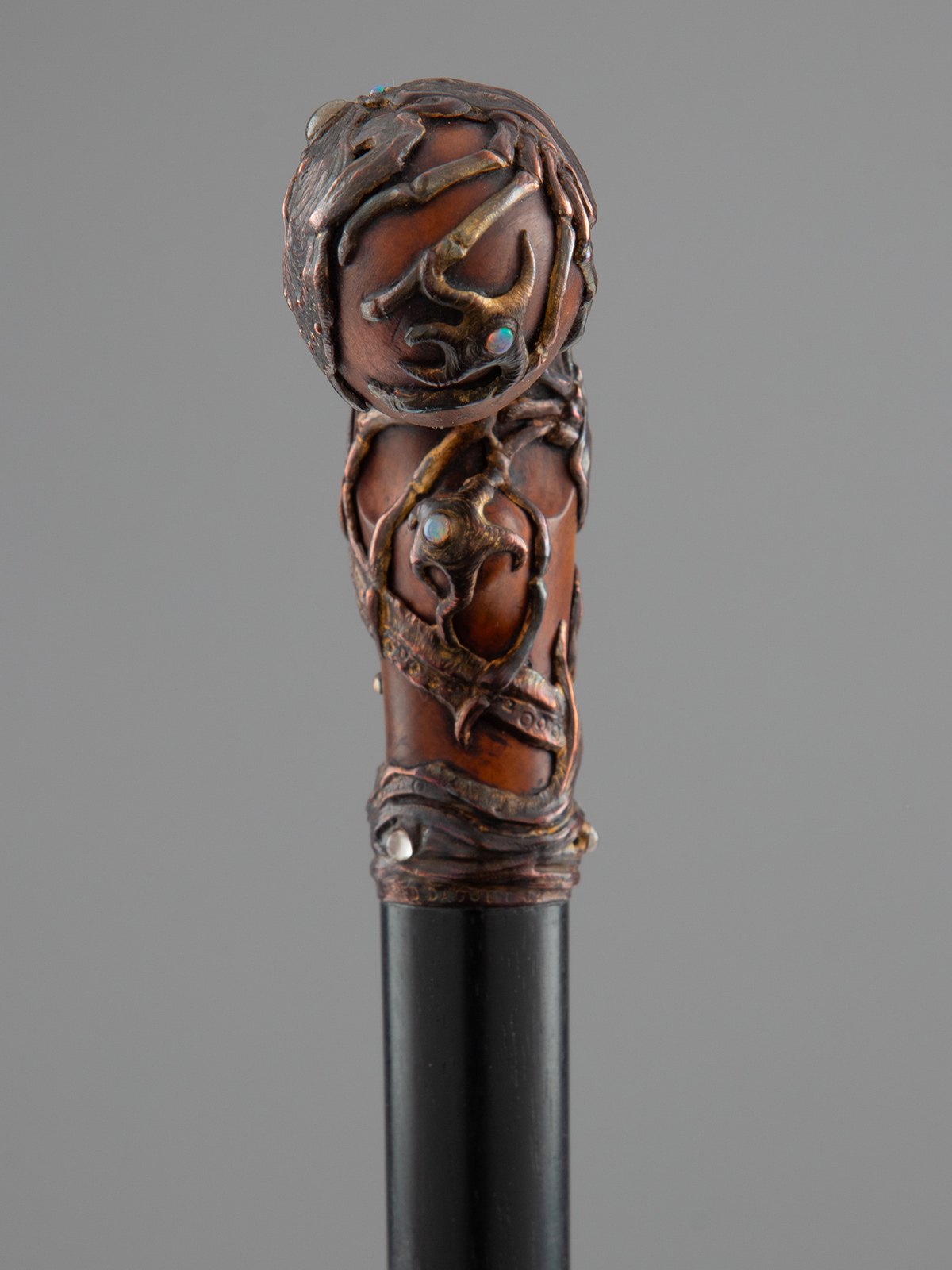
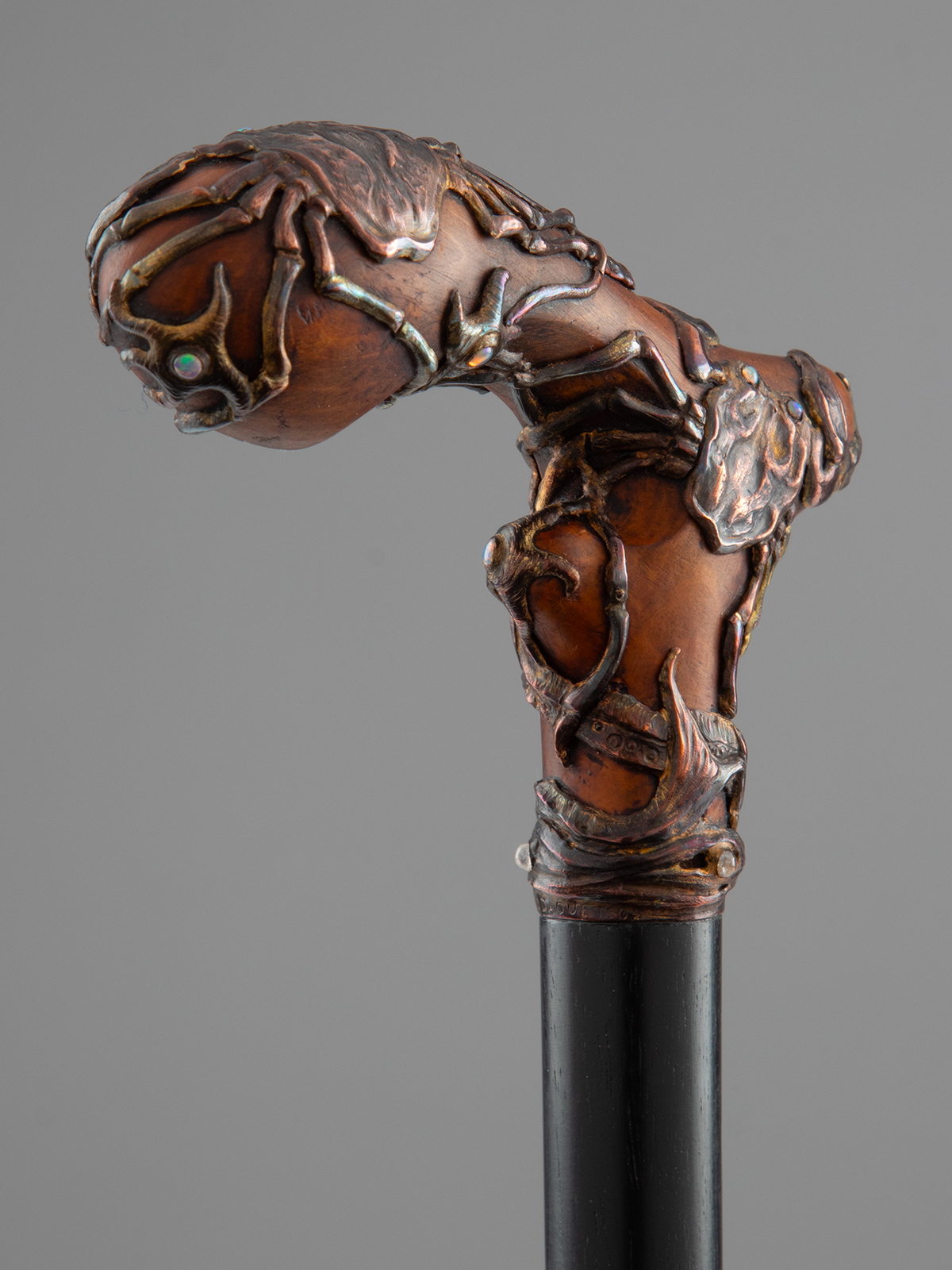
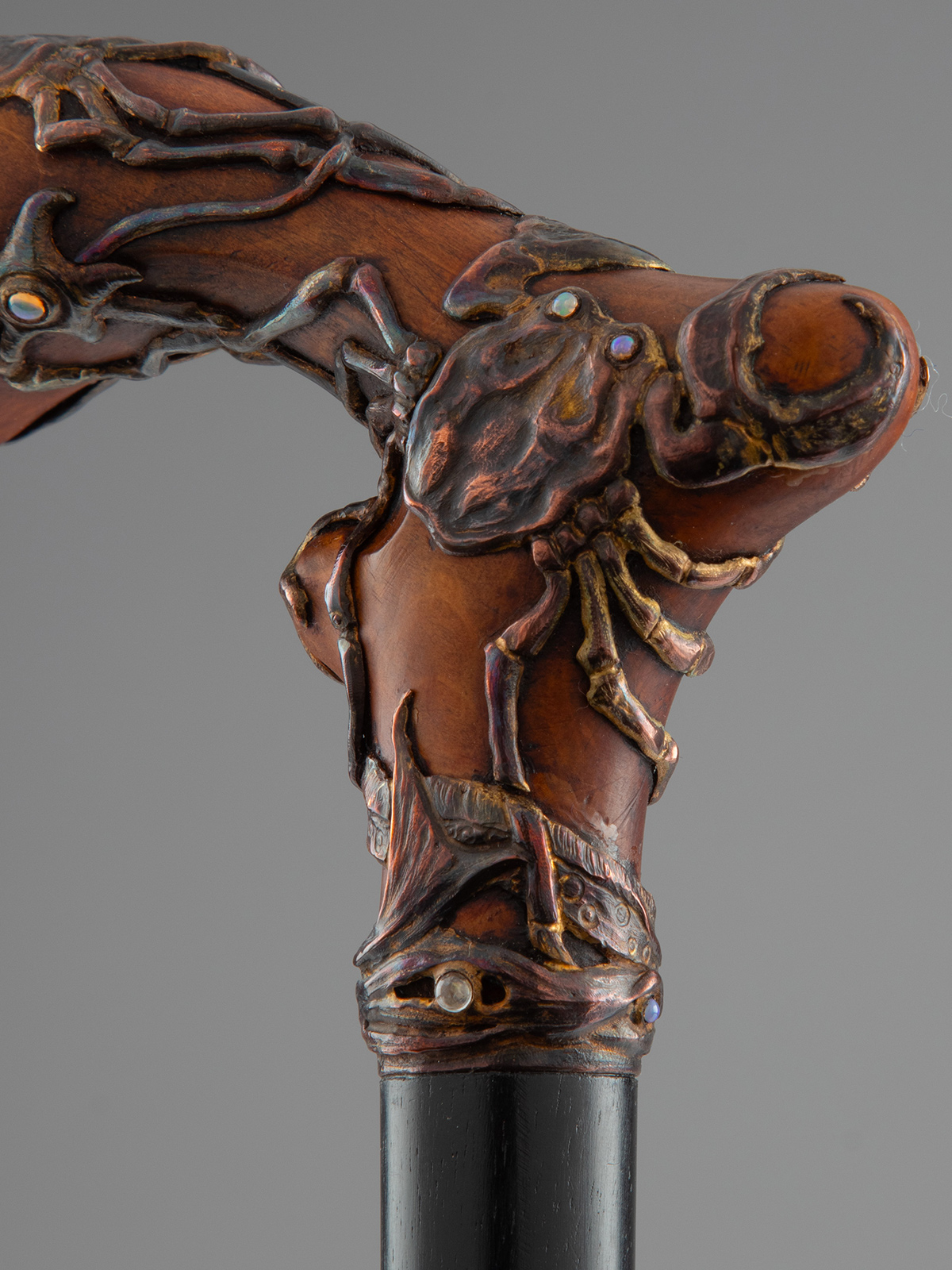
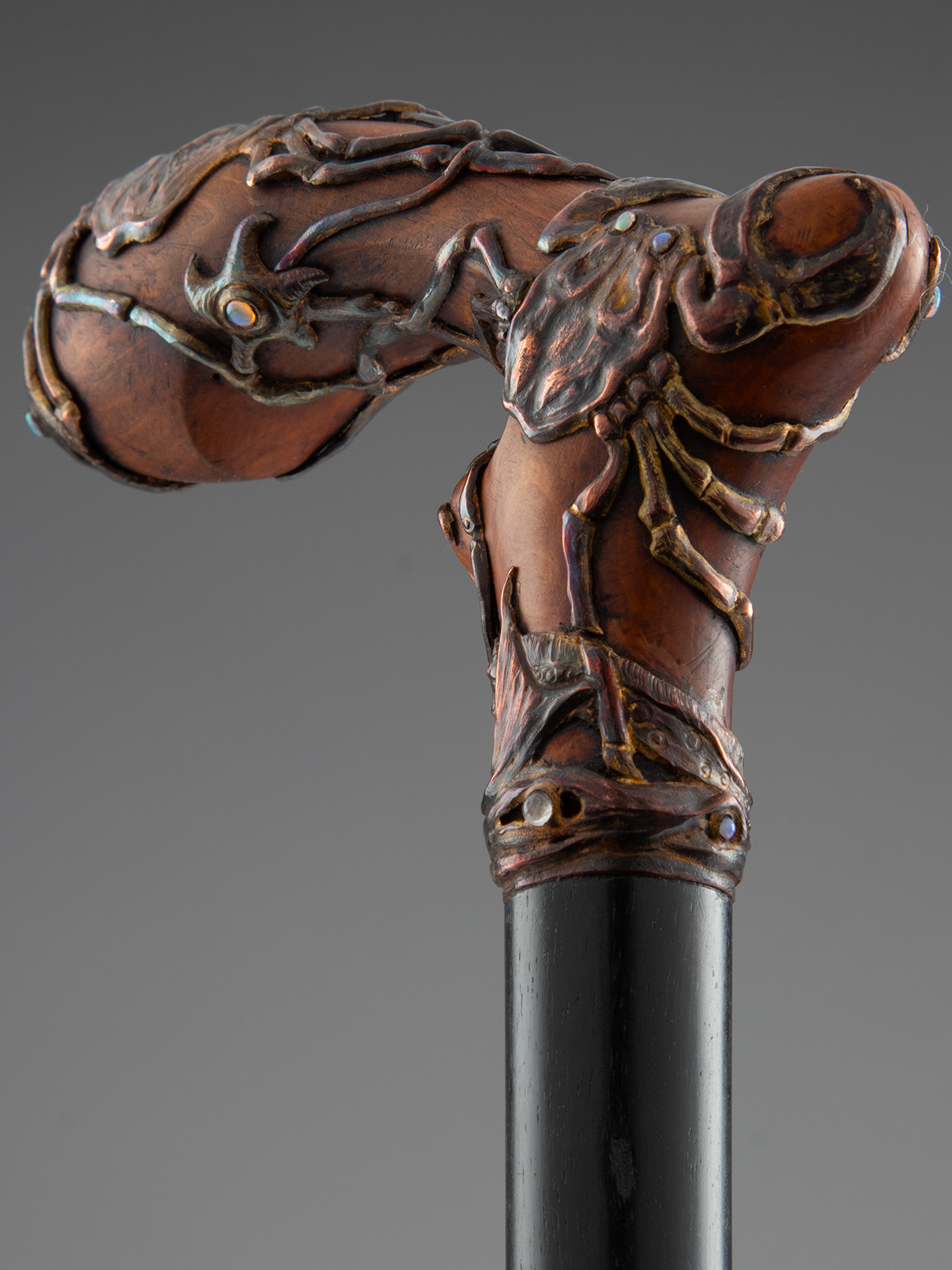
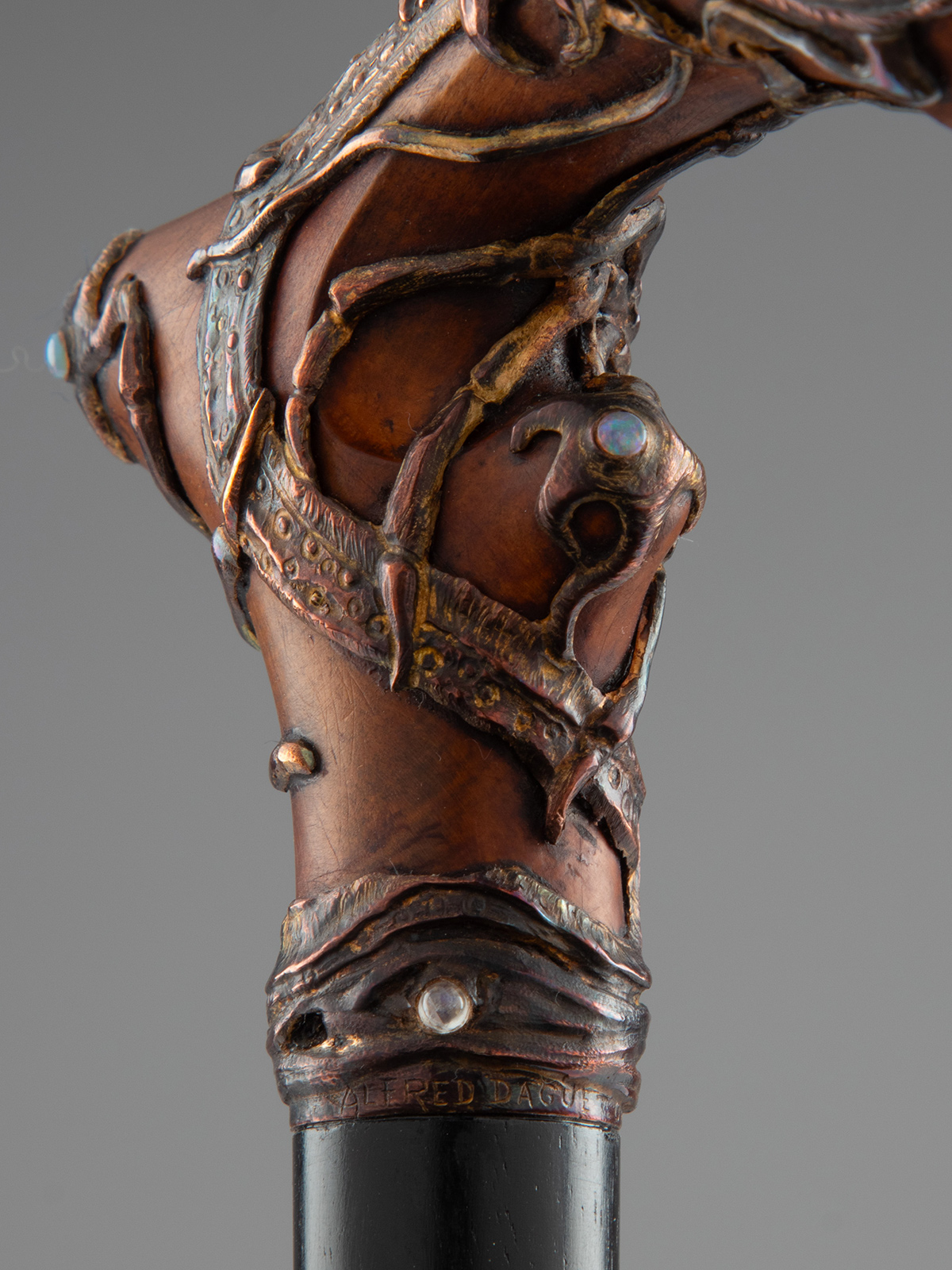
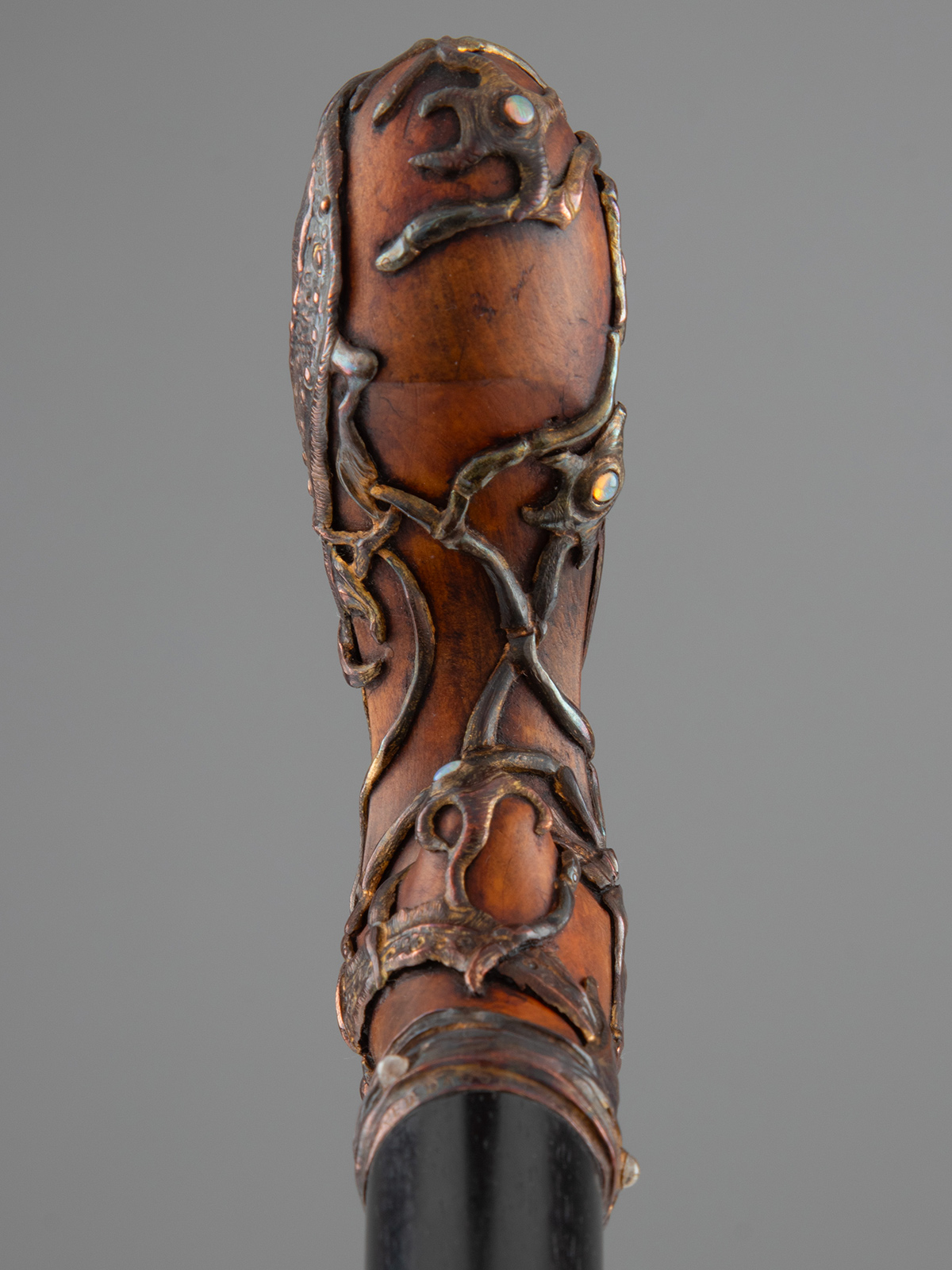
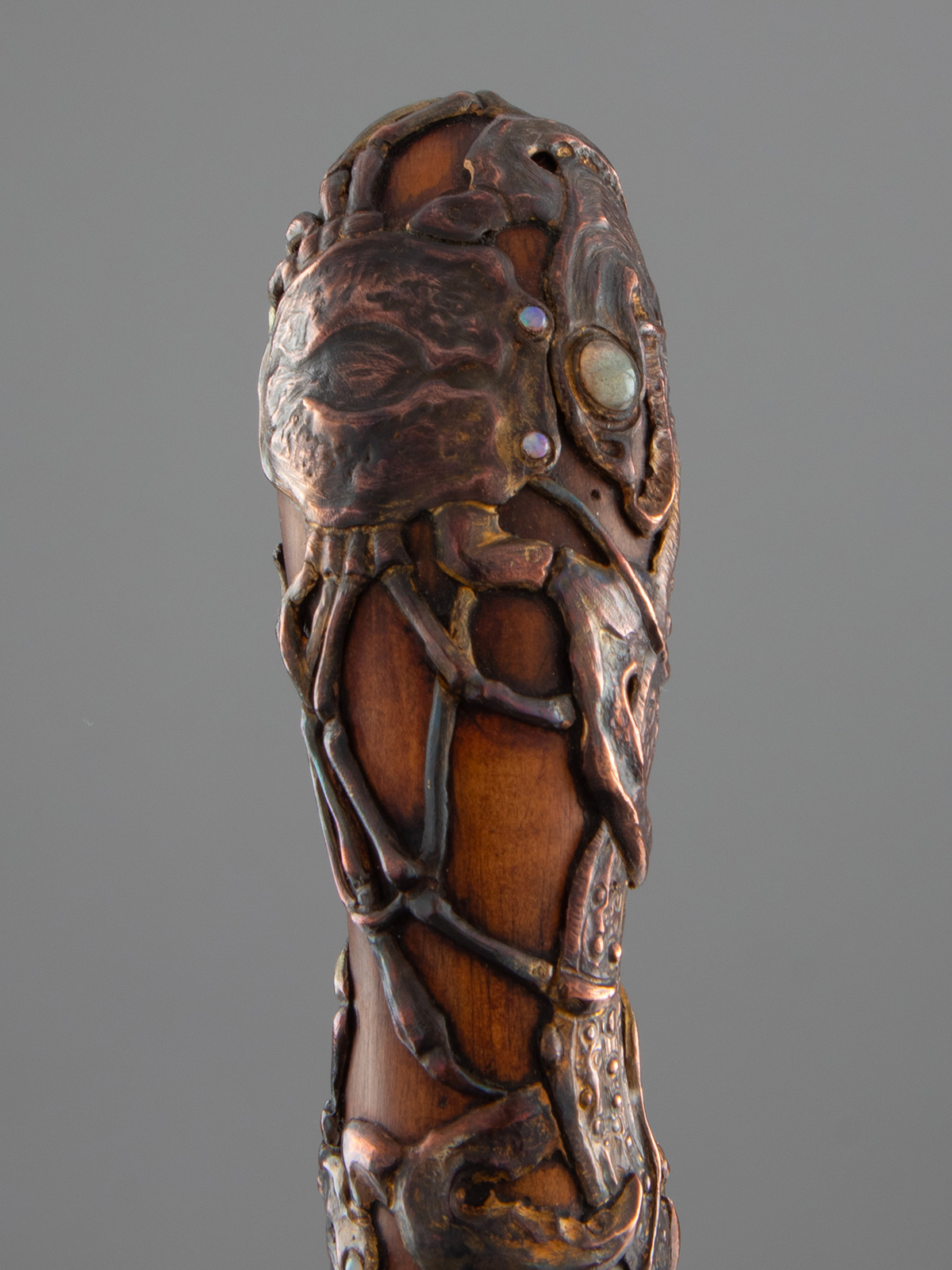
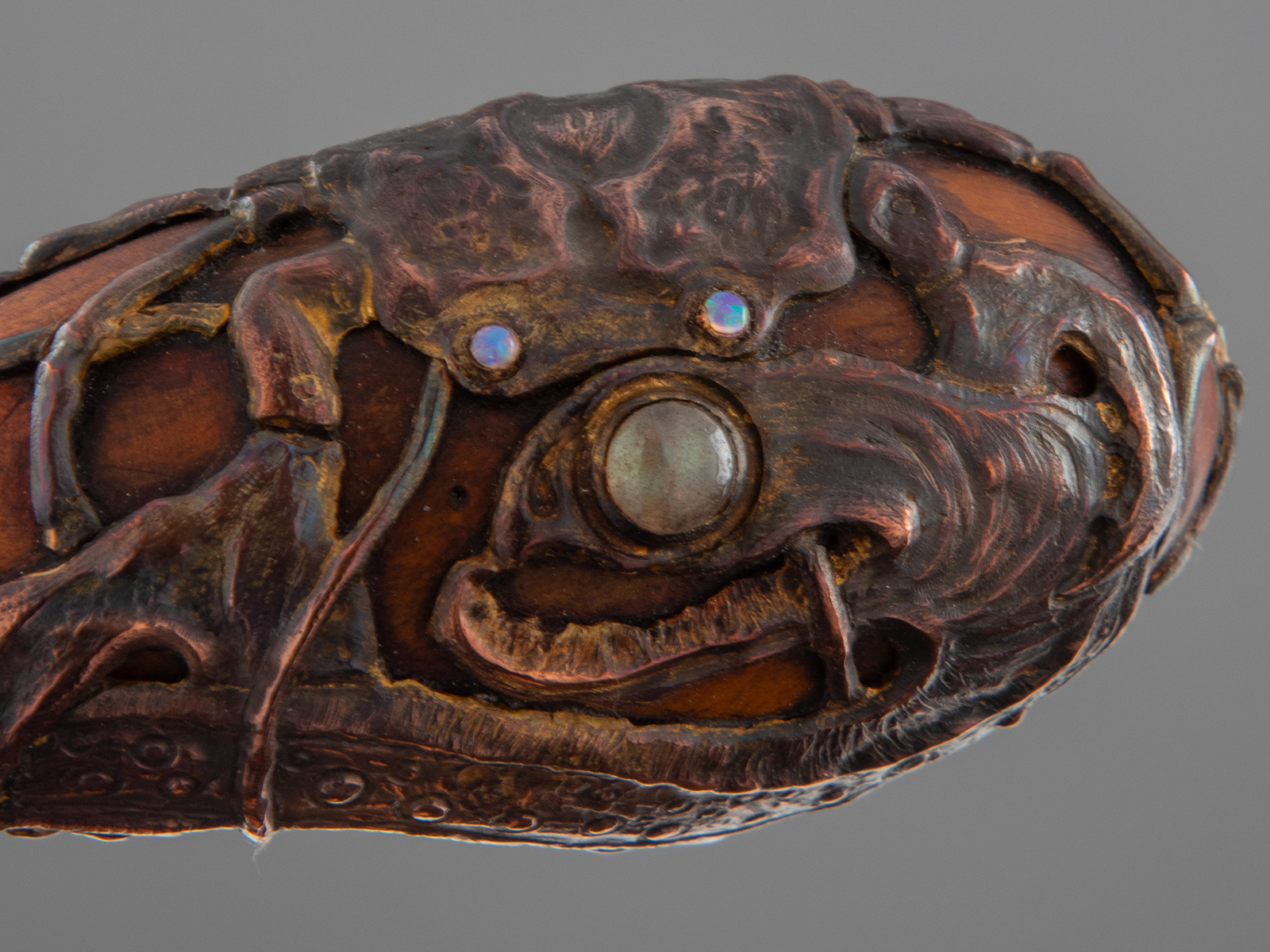
Art Nouveau walking stick, boxwood knob with copper-plated bronze applications depicting a fish, crabs and starfishe. Signed Alfred Daguet, Paris, France circa 1902.
Paris, France circa 1902.
7500 EURO
Art Nouveau walking stick designed and crafted by Alfred Daguet. The L-shaped handle is crafted of boxwood with copper-plated bronze applications, depicting a fish being attacked by the claws of two crabs. Starfish adorn the background. Cabochon-cut opal stones are set in the eyes of the fish and crabs. Cabochon-cut labradorite stones emerge from the waves of copper-plated bronze decoration, whose iridescent surfaces shimmer with varying light and angle. A dotted background peeks out from the thin space between the upper and lower figures and the embossed collar ring, signed and dated. Ebony cane with iron and brass ferrule. Alfred Daguet (1875–1942) was a renowned Parisian goldsmith in the early 20th century. Fascinated by Orientalism, he studied with the painters Jean-Léon Gérôme and Georges Clairin, both travelers in Asia and teachers at the École des Beaux-Arts. Daguet’s interests lay not in painting but in decorative metalwork, and he joined Siegfried Bing’s Maison de l’Art Nouveau at 22 rue de Provence (p. 131). His studio was located above the gallery, and some of his works bore the stamp of Bing’s studio. When the decline in interest in Art Nouveau led to the closure of Bing’s gallery in 1894, Daguet moved to a studio on rue du Faubourg-Saint-Jacques, where his clients included Lionel Barrymore and Sarah Bernhardt. He worked with iron, brass, and copper, and used enamels and cabochons. During World War I, assigned to an aviation group, he produced over two thousand drawings and watercolors of domestic and foreign aircraft, an extraordinary collection now housed at the Musée de l’air et de l’espace at Le Bourget Airport, near Paris. After the war, Daguet’s works, crafted in bronze and steel, took on a more religious connotation. He exhibited at the Paris Salons of 1900, 1903, 1905, 1909, and 1910, and at the Société nationale des beaux-arts in 1901. His works were also exhibited at the Musée de la Mode de la Ville de Paris in 1905 and 1926.
35,5” – 90 CM H 4,5” – 11,5 CM L 1,25” – 3 CM D
REF: M6293